
Receipt of natural anodised aluminium
Incoming material with unsealed anodising (open pore); incoming inspection and validation of the starting finish.
Anodic printing technique in which the image is embedded beneath the aluminium's oxide layer. The result: indelible information, resistant to UV, chemicals and abrasion, with a service life equivalent to the metal itself.
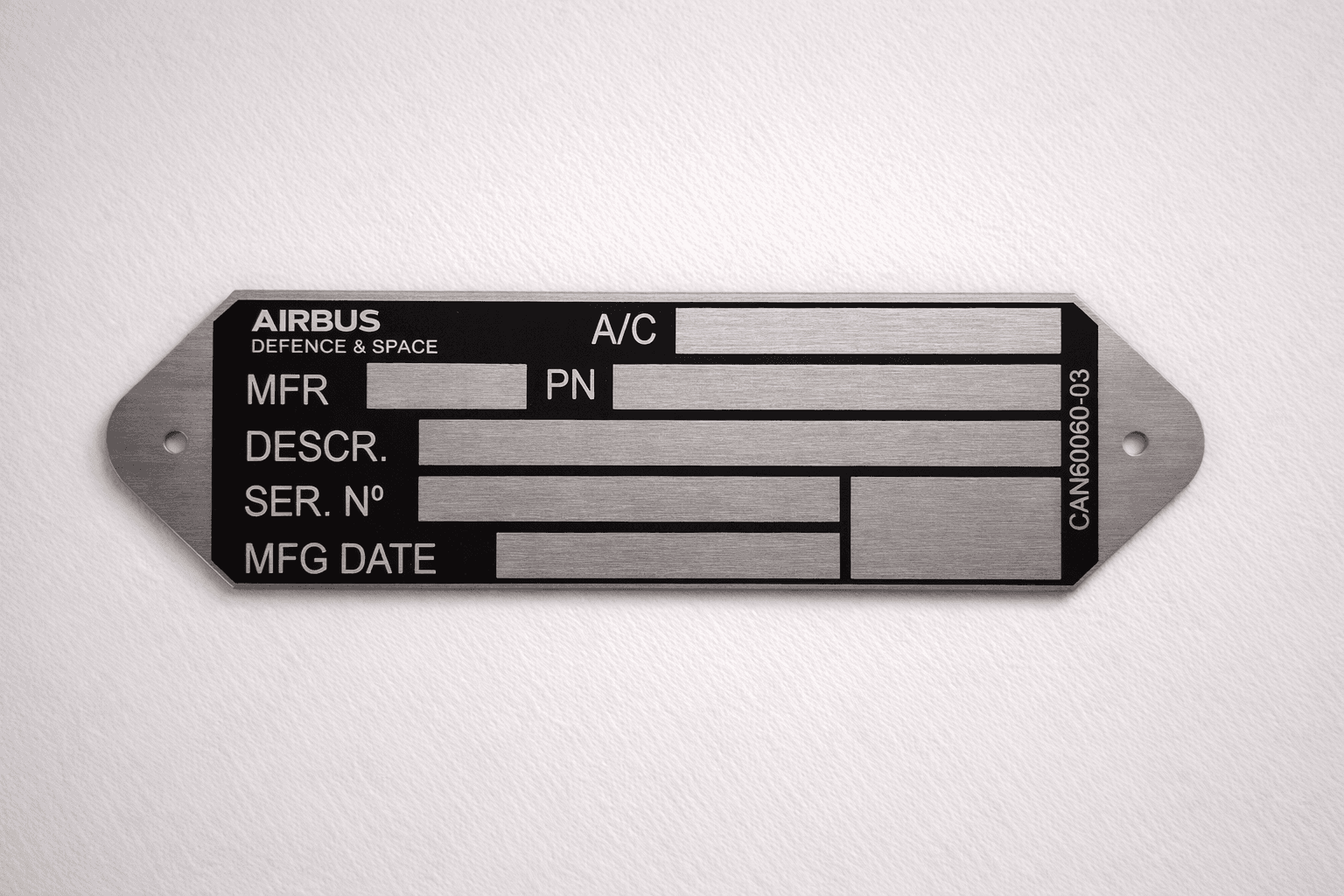
Photo-anodising, also known as anodic printing, is a technique in which the image, text and information are introduced into the aluminium's anodic layer before final sealing. The information becomes physically embedded beneath the transparent oxide of the anodised aluminium, rather than printed on the surface.
The technical consequence of this is that the result has the same durability as the aluminium itself: decades of resistance to UV, thermal cycling, mechanical abrasion, common chemicals and intensive cleaning. It does not fade, peel or scratch under normal use.
AMBAR ITC has its own screen-printing processes on unsealed (open-pore) anodised aluminium, with in-house final sealing baths. Classic anodic dyeing also makes it possible to introduce uniform colour into the anodic layer itself.
Lo que distingue a esta técnica frente a alternativas convencionales.
It is applied exclusively to natural anodised aluminium (silver colour) with unsealed anodising. Suitable for rating plates, technical plates, aeronautical identification, corporate logos and outdoor identification.
For coloured parts (red, orange, yellow, blue), we work with pre-coloured anodised aluminium onto which we apply other techniques, or we use photo-anodised UVI printing (a screen-printing + UVI combination).
Pasos típicos del flujo productivo. Sin cifras cerradas: cada proyecto se ajusta a especificación.
Incoming material with unsealed anodising (open pore); incoming inspection and validation of the starting finish.
Cleaning and conditioning of the substrate to ensure correct anchoring within the anodic layer.
In-house screen-printing process onto the open anodic layer. The image becomes physically lodged within the oxide.
Sealing in our own baths. The anodic layer closes with the information embedded, giving it its characteristic durability.
Dimensional, finish and legibility control before moving to packaging. Process records retained.
Individual or batch packaging as per the specification, with deliverable documentation where applicable.
Trabajamos rangos habituales del sector industrial. Casos singulares se evalúan bajo consulta.
We work with the thicknesses and formats common in the industrial and aerospace sectors. Special requirements of thickness, large format or tight tolerance are assessed on request.
Standard prior anodising is coordinated with specialist suppliers to our specification, with incoming control. For base-colour anodising we work on pre-coloured anodised material.
Las dudas más habituales que recibimos sobre esta capacidad.
Equipo técnico de AMBAR ITC analizará tu pliego y devolverá propuesta detallada en 24-48 horas laborables.